Most people who know me already knew this. Here's a video reenactment
Friday, April 29, 2011


Wednesday, April 27, 2011
A discussion on future fiscal debates

I still don't have time to post, but this was kind of substantive so just read it or whatever.
Canadian
gart, u there?
me
i am
Canadian
can i ask u a question re US politics?
me
yes you can
you ALWAYS can
Canadian
basically, what is the budget situation right now?
me
budget or deficit
Canadian
i know there was a couple of short-term measures to maintain current govt speding at 2010 (2011?) levels.
has obama put forward a new budget?
has it been debated, passed?
budget
me
ah yes
yes
Canadian
i know defiicit is huge. have they voted to increase teh ceiling?
me
2011 they had a last minute deal that passed about 2 weeks ago
literally, govt was going to shut down in an hour and they worked out a compromise with republicans
obama put forward a budget but republicans said no
so they had a compromise
that funded the govt through fiscal year 2011
they have not voted to raise the debt ceiling - that is what the next big fight is about
Canadian
ok, what is fiscal year 2011? that's oct 2010-oct 2011?
me
it'll have to be raised by june/july or the shit will be horrible
i'm not 100% but i think it goes through early spring 2012
Canadian
ok so the last development was two weeks ago with another continuing resolution?
me
there were a few short-term extensions, so that's why it didnt' get passed until april
right
Canadian
ok and when did obama put forward his budget?
btw you are being so helpful
me
haha good!
he announced his budget in the state of the union address in january and publicly released it around the same time
Canadian
basically current sitaution is: gov't is working via a continuing resolution prob through early 2012; at some point this summer there will be a debate over the debt ceiling; and there is a huge ideological divide in congress
me
that is 100% correct
oh and one more incidental thing
republicans say they will only vote to raise the debt ceiling if there are massive spending cuts attached to it
Canadian
but that is pointless then haha
me
yes
Canadian
why have a high ceiling if you aren't giong to go near the ceiling
me
to make it double-pointless is -- even if the republicans got every last thing they have asked for, they'd still have to raise the debt ceiling
Canadian
why will this issue be raised soon, if the gov't has a short term resolution to continue at current spending levels to 2012?
me
so they're just engaged in hostage-taking, essentially
ah
excellent q
Canadian
oh i see. got it re the ceiling
me
the continuing resolution for spending is just for the government to continue to pay people to do their jobs (postal workers, IRS, military)
the debt ceiling is different, and strangely unique to the US
the U.S. is the only country that says how much the treasury can borrow
this doesn't really make sense
Canadian
ahh ok very helpful
me
bc they pass laws saying "do this which will cost like $1billion"
but then they ALSO have to pass a law saying "you can now borrow $1billion to do that"
most countries just say "if congress passes a law saying we are going to spend money, that automatically means they can borrow it if need be"
Canadian
hahahah god
and...if you were looking at this US situation from the perspective of a canadian business, what questions would you have? hahahha
me
and the TRIPLE ironic thing is that this only happened (the debt ceiling vote) in the mid 90s when republicans wanted to get more leverage over clinton to do exactly the same thing they're doing now
so fiscally, it makes no sense -- it's purely a political issue
well
i think the debt ceiling will be raised
i think it will go pretty much down to the wire
but structurally, the incentives are (mostly) there to raise it
the last 2 big times that a deal had to come down were tax cuts in december 2010 and the budget deal just 2 weeks ago
both times they worked things out
everyone knows the debt ceiling has to be raised
the republican speaker of the house (who is the #1 negotiator with the white house on the debt ceiling) has said he knows it would be catastrophic if the debt ceiling weren't raised
everyone knows that if it's not raised it'll make america look unsafe and could literally make people stop investing in the dollar
but at the same time, this is leverage and the republicans are going to see how much in concessions they can get from the white house before passing it
that's the rational end - the irrational argument is that the republicans are crazy and don't mind ruining the US economy unless incredibly massive spending cuts are implemented
Sent at 12:32 PM on Wednesday
Canadian
ok well put.
the republicans do seem irrational
how anyone votes for them is beyond me
this has been really helpful. a good summary
me
they're irrational-ish
some of them definitely are, yet they keep actually making deals
it's kind of in their interest for people to doubt their sanity
bc they can extract more concessions that way
Sent at 12:35 PM on Wednesday
Canadian
ya and their supporters get all worked up and rally behind the issues
brb
me
right
that's the other end to it
the grassroots of the republican party IS actually fairly crazy and also has MORE power than they've ever had before
politicians are self-interested, so it's making people who used to be semi-sane say some fairly nutso things
Sent at 12:37 PM on Wednesday
Canadian
sorry, one more question -- when will the next debate be regarding the budget?
me
next year
the most optimistic situation is that there is a comprehensive & bipartisan deficit-reduction act that passes before then
then the spending bill wouldn't be controversial, bc the issues would already be worked out
Canadian
until then its up to depts and agencies to work with what they have and decide how to spend it?
me
the more likely result is this all happens again next year -- under clinton there were 2 shutdowns, one in 95 and one in 96
well the depts and agencies are fully funded until next year
then if there's not another continuing resolution, they get more money
Canadian
I'm wondering where the bulk of the money is going and how this is being decided -- e.g. to defense, core programs like medicare...?
me
ah yes
http://www.nytimes.com/interactive/2010/02/01/us/budget.html
that's not what passed
Canadian
like, how is it being decided that e.g. spending for science and tech research projects should be cut but defense spending stays high?
me
but the numbers will prob be roughly the same
Canadian
ok great. and who decides these numbers?
compromise?
me
a lot of them are just predetermined
Canadian
so these numbers stay approx same until early 2012 when they try to pass a real budget?
me
as you can see, a huge proportion of it goes to, essentially, insurance programs
right
Canadian
and what about thsi reduction act?
you mentioned. how will that impact where money is spent?
me
so you can kind of predict like, how many people will be getting social security or filing for medicare
you know how much the wars are gonna cost
the thing people fight about is all in the bottom right corner - transportation, education, agriculture, energy - but those are all tiny parts of the budget
to get the deficit under control, you need to address the big chunks - social security, medicare/medicaid, defense
that's like 75% of spending
that's what the deficit reduction plan will address
Wednesday, April 20, 2011
Liberals and Conservatives Both Won Too Much

A while back, Yglesias wrote a semi-inflammatory post essentially arguing that liberals have won. FDR started the process of social insurance for white elderly folks, and since then that safety net has expanded to provided a baseline of social insurance (retirement and medicine) to everyone. This culminated with ObamaCare, which officially granted (near) universal health insurance to all Americans, regardless of income. Any future changes to this will either be tinkering about how to pay for these programs, or conservatives roaring back and eliminating them.
I think that's 100% right, and something liberals should really keep in mind. But the flip side to that is that conservatives have won too. Ask an ideological conservative the #1 thing they want, and the answer will be "lower taxes." [Smaller government might be an argument, but that's really not what conservatives have fought for -- including Reagan. Government has grown hugely under Reagan and Bush, the two most electorally successful Republican presidents]. Anyway, taxes are historically low now -- so Republicans won that battle too.
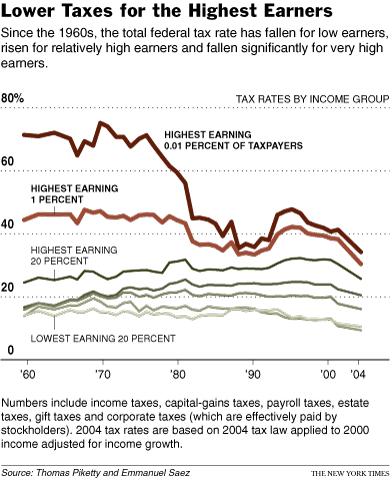
That is really the cause of the deficit. Both sides won! In the next few years though, one side is going to lose - we're either going to eviscerate some of the social welfare programs we've put in place or raise taxes (particularly on the top 20%). It'll be interesting.
Friday, April 15, 2011
Bipartisanship and Deficit Plans

Lots of interesting but boring-to-99%-of-the-population stuff about the deficit today. I don't want to recap everything...oh FINE I will.
Paul Ryan/Republican Plan: "cuts" $4.3 trillion in 10 years. scare quotes used bc a) his numbers don't add up b) no one can actually predict what our deficit will be in 10 years with any kind of certainty. that's like me asking you what your credit card debt will be in 10 years, so fundamentally this whole debate is about hypotheticals and the numbers are pretty screwy. Anyway - Ryan gets the cuts by turning Medicare into a block grant program (which means instead of covering your insurance when you're an oldtimer, you'll get a certain amount of money to buy your own insurance), raising the retirement age, cutting taxes on rich and raising them for the middle class/poor, fully repealing ObamaCare and Financial Reform Act. i think that's basically it.
Obama Plan: "cuts" $4 trillion in 12 years. Raise taxes on people making over $250,000, fully implement ObamaCare to cut health care costs, continue to invest in research & development, slash defense spending. This would be about $2-3 dollars in spending cut for every $1 dollar in new taxes. Oh and reform the tax code, which would save a lot of money.
Surprise! Republicans like Ryan's plan, Democrats like Obama's plan, and Moderates want to split the difference. You've got moderate folks like David Brooks and Max Shifrin endorsing what they call a hybrid approach comprising of the following:
- Aging populations, expensive new health care technologies and the extravagant political promises have made the current welfare state model unsustainable. Fundamental reform is necessary or the whole thing will collapse, here and in Europe.
- Seniors and the middle class cannot be excused from the benefit cuts that will have to be imposed to rebalance these systems.
- Health care costs will not be brought under control until consumers take responsibility for their decisions and providers have market-based incentives to reduce prices.
- Tax increases on the rich have to be part of a fiscal package.
- Government investments in research and infrastructure nurture broad-based prosperity.
That's the hybrid. There's kind of a big problem in that though, in the sense that it's...um...like...actually not a hybrid at all. Let's work in reverse order:
5. Obama's plan has investment in research/infrastructure, and (I think) Ryan's does not.
4. Obama calls for new taxes on the rich. Ryan has 100% said that is completely unacceptable.
3. This just isn't true. Medicare - government-run health care - does a better job of controlling costs than the private insurance market. Health care costs in countries with government-run health care see their health care costs increase at a slower rate than those with more private markets. Why? Because health care is different - unlike most things, where people make a rational, market-based choice, people rarely do that when their loved ones lives are at stake. The free market is not the best way to deal with health care costs.
2. None of Ryan's cuts come from people younger than 55 years old. Obama's cuts do.
1. Ryan's plan doesn't really have fundamental reform...it just shifts the rising cost of health care from the government to individuals. It repeals ObamaCare, which is actually forecasted to slow the rate of health care cost growth.
So long story short, the moderate, consensus view is basically Obama's plan. Oops.
Wednesday, April 13, 2011


Sunday, April 10, 2011
I realize I don't read enough news

So I added some new blogs/news sources to my google reader. Things are already looking up! Here's an excerpt from The Monkey Cage (blog written by legit political scientists - they're generally better at analysis than journalists) on Obama's presidency - it's pretty astute, methinks.
Two years in to Obama's presidency it has turned into a Rohrschach test. Indeed, while Obama's approval ratings are higher than those for Reagan or Clinton at comparable points in their terms, support for Obama is as polarized as it has ever been for any recent president. Democrats and Republicans seem to be observing different presidencies. Left-leaning ideologues hoping Obama would be the liberal lion have been disappointed since Obama advocated a surge in Afghanistan, failed to close Guantanamo Bay, dropped the public option on health care, and extended the Bush tax cuts. Moderate supporters hoping for a post-partisan pragmatist watched as the president pushed through policies such as health care and the stimulus that were supported by less than half of the public on partisan lines.
Why the different opinions about Obama? Perhaps it is because Obama has learned the leadership lessons of the modern presidency better than any other president. Many factors have shaped Obama's actions, including the context of his presidency and the Republican resurgence but he is working from a playbook written by the late Harvard presidency scholar Richard Neustadt. Following the advice of Neustadt frustrates ideologues, confuses pragmatists, and can energize the opposition.
As Neustadt advised, Obama started with a clear agenda but sequenced his legislative initiatives effectively so as not to overload Congress. As Lyndon Johnson explained, Congress is like a whiskey drinker. If you try and force too much down their throat at once, they'll throw it up but if you get to drink sip by sip you can get them drunk. Careful sequencing of legislative initiatives means that some people are going to be disappointed, usually those supporters who have been led to believe the president will make everything (or at least the issue most important to them) better right away.
President Obama also began his presidency with vivid demonstrations of his tenacity and deal making ability. These demonstrations are necessary, in Neustadt's reckoning, to prove to the Washington community that the president is not someone to be trifled with. There are costs to opposing the president and benefits to siding with the president and what the president says he will accomplish, he will accomplish. The reputational benefits of such early demonstrations pay off later in the president's tenure. This helps explain the president's dogged persistence early in his term on some big ticket items that were not particularly popular and passed largely on party-line votes. Where is the compromising pragmatist?
Fundamentally, Neustadt advised that presidents make decisions today with an eye toward tomorrow. President Obama has protected the power of the presidency, most noticeably by continuing to use signing statements. The president has also issued notable executive orders on topics such as gay rights and abortion and centralized power in the White House via czars. In public appearances Obama has sought to generate support for the president and his brand as much as for his programs. Where Obama is criticized for vagueness and a refusal to engage, one explanation may be that people misunderstand the purpose of his public activities. The president wants to generate support but prefers to be less specific in order to protect his bargaining flexibility down the road.
The modern president who is a good student of the office may be a Rohrschach president.
Saturday, April 9, 2011
Security vs. Insecurity

I've got this buddy Max who is also the proud owner of a nerdblog. I'm not sure how I'd characterize his politics - inherently skeptical, but more sympathetic to tax cuts than government spending. His whole blog is worth reading. He grapples with things.
Anyway, he characterizes liberalism as follows:
"This dichotomy, which still persists to the present day, is the fundamental advantage possessed by big government liberals. They are seen as political Robin Hoods, fighting for the poor and disadvantaged against the corporate elites with the small government politicians in their pockets. No matter what lies beneath this superficial classification, they always seem to harp back on the theory that small-government conservatives want to take from the poor and give to the rich."
I take issue with that. Sure, liberals talk about the poor a lot, but that's not really what liberalism/big government is about. "Big government," in the pejorative sense that politicians love to harp on, is about one thing: security.
Watchoo talkin' bout, Gart? Hm. This is what I mean -- the fundamental planks of a liberal's dream state (spoiler alert - we're pretty close to having one!) is a country in which everyone - be they rich, poor, or, most crucially, middle class - has some measure of security in their life. Specifically, if you make less than the top 50% of the country, that means you'll make about $35,000 a year. Most likely, that isn't going to leave you much savings to fall back on when you retire, or when you face some kind of catastrophic illness (which almost everyone will face at some point), or whatnot. Big government is about providing a safety net so that you have a little less fear when those things happen, and a little more security through your life.
Crucially, this ISN'T about the poor - it's about everyone. Just because you're rich doesn't mean you don't get your Social Security check or Medicare. This is a real thing! What if you invested in one of Madoff's Ponzi schemes completely unwittingly and with no fault of your own. You did your due diligence. You studied up - no one knew he was a crook! Or Enron, or WorldCom, or real estate. You could go from being literally in the top 10% in terms of income, only to have all your savings wiped out. Social Security provides you a safety net so you're not living in poverty in your old age.
This is real. It's time for charts I think. Ok so Medicaid is the program we think of as providing health care to the poor, right? Well, not exactly:

I have to work. More later.
Wednesday, April 6, 2011
Two thirds of cuts in Republican Budget come from the poor

Tuesday, April 5, 2011
Deficit Reduction

Time to get back to the boring stuff. Paul Ryan, a Republican robot, released a deficit reduction plan today. It's bold, in that it makes hard cuts in areas we need to, and also really stupid, in that it makes a lot of cuts in programs that help support poor children, the elderly, and the disabled - while cutting taxes for the rich (again!). It's funny how we can be the richest country on the planet yet still be the stingiest when it comes to helping the sick, poor and old. Give us your tired, your poor, your huddled masses indeed!
Anyway. One of my favorite things about politics is that people repeatedly base decisions on ideology instead of experience. "Government is wasteful! Let's cut it!" says every Republican ever. When really government waste is minimal, and Medicare and Medicaid have less waste than private health insurance. Interesting and factual! But it won't convince any Republicans to preserve those systems because...um...I don't know why.
You know what's interesting? We recently had a budget surplus! Oh yeah! Didn't Clinton do that? How interesting! Maybe instead of just y'know listening to Republicans (who presided over the ballooning of the budget in the first place under Bush), we should look to how we balanced the budget back then. Let's see...
1) Let the Bush tax cuts expire for the love of Jesus! They cost like $150 billion. THAT IS A LOT. We were incredibly prosperous during the Clinton years and did so just fine with slightly higher taxes. This is obvious.
2) Stop going to war. They cost a lot of money. This includes Libya, probably.
3) Stop enacting programs without paying for them, like Bush's Medicare prescription drugs program. Example of a good new program: ObamaCare, which is 100% paid for. Example of good exception to rule: Stimulus, because the only time you should really have deficit spending is during a recession, to stimulate demand. If any conservatives read this blog they will not like this.
4) Stop having recessions. That's kind of pedantic, but that means we should probably stop doing things that lead to the loss of jobs - like cutting spending programs when we still have 18million+ people unemployed. And we should have strong regulations of the banking industry that stops those jerks from doing idiotic things like plunging the world into Great Depression II.
That's where you should start. Because, y'know, it has a proven track record of success. Evidence, you jerks.
I love bears part 802,859
This cute bear animal post is (as usual) brought to you by Senior Animal Expert & Asian Correspondent Grace Hong.
Monday, April 4, 2011
Kenny's Kanadian Kolumn Reacts
People really liked Kenny's Kolumn. It was so Kanadian! The email box has been flooded with responses here at Gart Central -- and by flooded I mean Morgan keeps sending me creepy pictures and Rush keeps writing things in French or Martian or something. Here are some highlights:
 Morgan insisted I post this. When I asked her for a caption, she said "I HAVE NO COMMENT." That is a direct quote. Morgan is funnier on her own blog, which will soon be ready for primetime.

Bachmania!
Michele Bachmann is running for President. This is what she looks like:
 I like her a lot, in the sense that she is really fun to talk about and you know dangerous for America and an idiot and stuff. One of my favorite things about her is that she really understands gay culture. As everyone knows, Elton John is gay. Unsurprisingly, Michele Bachmann knows this too! She also knows what Elton John being gay means for America:


"Normalization (of gayness) through desensitization. Very effective way to do this with a bunch of second graders, is take a picture of 'The Lion King' for instance, and a teacher might say, 'Do you know that the music for this movie was written by a gay man?' The message is: I'm better at what I do, because I'm gay."
Similarly, Ricky Martin is gay. Don't tell any first graders! Why couldn't I think of a better example of a gay person than Ricky Martin? Oh wait.

I really enjoy How I Met Your Mother, which really has nothing to do with anything. Anyway, Michele Bachmann is legen-wait-for-it-dary and I can't wait for her to run and get an embarrassing amount of Republican support before eventually losing to someone I will make fun of at a later date.
Kenny is funnier than me
Shit! Kenny's post was really good. I have nothing interesting to say today so I'm just going to post a cute video about a dog.
Kenny's Kanadian Kolumn

Dear Americans:
It gives me great pleasure to educate you aboot the upcoming election in Canada. Despite what you’ve heard, Canada is actually a real country. It even has a president (except we call our president the “prime minister”, but I will henceforth refer to him as the president so as not to confuse you, my American friends), whose name is Stephen Harper. In Canada, unlike in the United States, there is no direct election for president. So, the leader of the Party with the most seats in the House of Commons (the equivalent of your House of Representatives) becomes the president. Although Mr. Harper and his Party, the Conservatives, won the last election, they formed only a “minority” government. This means that the other parties in the House of Commons had, combined, more seats than the Conservatives, though the Conservatives had more seats than any other individual party. The problem with a minority government is that, if the other parties choose, they can vote together to dissolve Parliament and call an election. This is precisely what happened two weeks ago. As a result, there will be a Canadian election on May 2, 2011. Please try to contain your excitement, my American friends.
Over the next few months, several people will compete to become the next President of Canada. In Canada, instead of a White House, we have the Ice House, which is an exact replica of the White House except that it is made entirely of ice, where the president must live. As a result, most people in Canada do not want to become president. Nevertheless, the following characters have stepped forward: Mr. Harper, who is running for reelection; Jack Layton, the leader of the New Democratic Party, who stands no chance of winning so no one cares aboot him; Gilles Duceppe, the leader of the Bloc Quebecois, a party that is devoted entirely to the separation of Quebec from the rest of Canada (the Bloc is only on the ballot within the province of Quebec, and so mathematically has no chance of ever winning an election); and Michael Ignatieff, the leader of the Liberal Party, the only man who has a chance to stop Harper.
The Conservatives will almost certainly win this election. The only question is whether Mr. Harper will have another minority government or whether this time he will form a majority government. Many people fear what President Harper would do should he win a majority of seats in Parliament. If he succeeded in doing so, his Party would be free to pass whatever legislation it chooses, since the other Parties would not be able to outvote the Conservatives, even if they all voted the same way (note: this assumes that the Conservatives all vote the same way on most issues, which, in Canada, is generally the case).
Now, Mr. Harper would likely be considered a crazy socialist in your country, but his platform is considered quite conservative in Canada, and threatens some deeply held Canadian values. He is thinking of modifying our public healthcare system in order to turn it into a private/public model, which would mean that richer Canadians could “opt out” of the public healthcare plan and purchase private healthcare. The fear is that this would result in poorer Canadians having access to worse healthcare, thereby creating a two-tiered system. The entire thing is upsetting since, as Dave Gartenberg will tell you, public healthcare is a big fucking deal. Mr. Harper also plans on boosting our military which, contrary to what you may have heard, actually exists. This is something that I strongly oppose, since if there is any benefit from living in Canada it is the fact that we let you Americans spend trillions of dollars on your military so that we need not spend a cent on ours. Mr. Harper is, then, trying to withhold us from our birthright: the right to mooch off of the American taxpayer.
Unfortunately, President Harper may succeed in winning a majority government and claiming the Ice House. This is because he is an evil genius, and runs some really good attack ads. In the one I’ve posted below, Harper attacks Ignatieff for living in the United States for many years, implying that Ignatieff is not a real Canadian (Mr. Ignatieff used to be a Professor at Harvard). It is actually really funny, and I laughed at first, before realizing that 95% of Canada was probably nodding along with this ad (we only have one tv station in Canada, so I’m assuming all my fellow Canadians were watching the same ad) and deciding to vote for Mr. Harper. Thus, he may wind up with a majority government and free reign to fully implement his conservative agenda for the first time. Only time will tell.
If you have followed this entire thread aboot Canada, I commend you, and invite you share a Labatt Blue with me on May 2 as we watch the Canadian election results pour in. Not for too long eh – theres hockey on that night.
Friday, April 1, 2011
Giraffes Neck Wrestle Too
Again, this post has research by Asian Correspondent "The Girl In Black" Grace Hong.
Over Obama

This is not change we can believe in. Unless Hillary runs for president, I am supporting Sarah Palin. It's time we had a woman in the White House.


Brooks on Libya

I like Brooks. He's a straight-shooter, even if I disagree with him say...65% of the time.
Recessions in context

Also something to keep in mind -- look at the most recent recessions in 2001 and 1990 -- those recoveries are very slow too. It's possible that just the modern economy has slower recoveries. Possibly bc of less blue collar construction/manufacturing jobs existing, so those folks don't bounce back as quickly? Something to think about.
Subscribe to:
Comments (Atom)