Total Pageviews

Thursday, March 31, 2011

Tax cuts

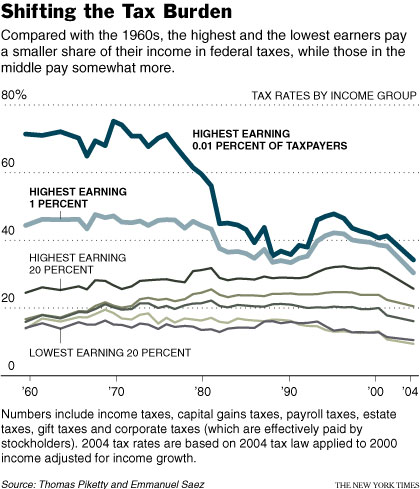
Here's a good one. I've talked about how taxes are historically low right now, which also means the government raises proportionally less money than ever. But does everyone share those cuts equally?


Nah.


The chart is pretty self-explanatory - people up to the top 80th percentile pay almost exactly the same as they have for the past 50 years. Some a little more, some a little less, but it's all very marginal differences.

It's only the top 20%, and really significantly the top 1%, that have seen any real cuts to their tax rate. Put another way, the tax cuts over the past 30 years have almost exclusively benefited the top 20%. That's not the coolest.

Taxes

I really like Ezra Klein. This morning, he wrote about what kinds of taxes different regions of the US pay to raise their revenue:

Here's the takeaway - not all taxes are created equal. Income taxes are progressive, in that the more money you make, the proportion of your income you pay; sales taxes are regressive, in that everyone pays the same flat tax (say 6%) on a new pair of socks, whether they make $20,000 a year or $20million.

Obviously, regressive taxes favor rich folk - it means they'd pay less money - and hurt poor folk - if you're poor paying an additional 6% on everything you buy can be a real burden, whereas if you're rich you often don't give it a second thought. I don't really have a point beyond that it's important to keep in mind the different ways we tax people, not just whether or not we tax them. Progressive tax systems are by and large fairer, because they impose a more equal cost relative to each person's earning power.

Priorities

What should be the domestic policy priorities of the US government? It's pretty important to think of things in this way - if all our conversation is on the 7th most important issue, we're by definition missing some big things. My list would probably be...

1) Unemployment/jobs
2) Strength of economy
3) Rising cost of Medicare
4) Climate change/energy policy
5) Social Security payment gap
6) National debt
7) Education
8) Immigration reform
9) Criminal justice/sentencing issues

That's generally how I feel in my gut, but it's hard to make a list like this. The big takeaway to me is that focusing on the deficit at the expense of or even at cost to the unemployed is really dumb. What's your list?

You know what's interesting about llamas?

Llamas that are well-socialized and trained to halter and lead after weaning are very friendly and pleasant to be around. They are extremely curious and most will approach people easily. However, llamas that are bottle-fed or over-socialised and over-handled as youngsters will become extremely difficult to handle when mature, when they will begin to treat humans as they treat each other, which is characterized by bouts of spitting, kicking and neck wrestling.

(Grace Hong provided research for this post)

Libya and American Exceptionalism


Obama's Libya speech was one of his better efforts. He rises to the occasion with foreign policy subjects, possibly because he doesn't have to hedge his bets. His domestic policy speeches generally have a "liberals believe X, conservatives believe Y, they're both somewhat right, so we'll do some of each," nature to them. Nothing wrong with that - the most memorable example was the whole "there is no red America and blue America, there is the United States of America!" from way back when.

I digress. His foreign policy speeches are usually more forceful "I believe X and this is why I am right." That's good too -- he's fairly persuasive and usually right. On Monday with Libya, the theme was American exceptionalism: the notion that America stands unique as a force for good in the world, and we have unique capabilities to stand up for freedom, self-determination, and the prevention of mass slaughters. Conservatives love American exceptionalism (although they generally think it means that Jesus loves America more than other countries, a pretty odd claim on a lot of levels) and liberals are fairly skeptical of it on the grounds that a) it makes us seem arrogant and b) we should focus on our own problems first, not go out solving everyone else's.

Anyway, the middle ground (I guess Obama did go middle ground again without saying it!) is that America should be humble and modest when it interacts with other countries, but we do fundamentally have the power to help those in need much more than almost any other nation - and under certain circumstances we should not hesitate to lend our aid, whether it be civil or military.  I think most people would agree with this - it's the justification for why we fought Hitler in World War II.  But taken too far in the wrong extreme you get situations like Iraq or Vietnam - wars that should never have been fought.  The other side of this is that the method of the fighting matters as well - Iraq I (Desert Storm) worked because our missions was just to push Saddam out of Kuweit; Iraq II failed because we occupied the entire country.

The point is, this shit is complicated. I am about 75% convinced that we should be involved in Libya helping the rebels fight the mad dog of Africa, Gaddafi. I'm not convinced we should be directly selling them weapons. And I'm disappointed that all of this has been done without congressional authorization - but that's really a critique of Congress at least as much as it is about Obama. So far, the war has been going well, but we need to be very cognizant not to get drawn too far into the conflict. I trust Obama's instincts of knowing when enough is enough - we'll see if he validates my trust. But this is one of those times that America should stand up for what is right.