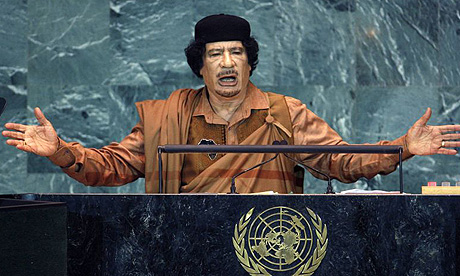
This guy sucks. Here's what he had to say today, annotated:
"I am a fighter, a revolutionary from tents [that's why i don't know how to dress]... I will die as a martyr at the end." [that would be cool! let's make it happen]
"I have not yet ordered the use of force, not yet ordered one bullet to be fired [this is a lie]... when I do, everything will burn [that is scary]."
"You men and women who love Gaddafi [no one knows Qaddafi's name is spelled with a G or a Q. obviously Q's are cooler, so from now on I'll use the G spelling] ...get out of your homes and fill the streets. Leave your homes and attack them in their lairs [lairs always sounds insidious but i think he means "public squares and parks"]... Starting tomorrow the cordons will be lifted, go out and fight them."
Shouting in the rambling speech, Gaddafi declared himself "a warrior" and proclaimed: "Libya wants glory, Libya wants to be at the pinnacle, at the pinnacle of the world" [blah blah i love africa and wearing window drapes]
Seriously, this is exactly the worry for these protesters in the rest of the Middle East: most regimes are REALLY OPPRESSIVE AND MURDEROUS. I think the best hope now is that the military turns on him and, yes, kills his brains out. There's not much the U.S. can do. Diplomatic pressure won't mean monkey crap to this loser-dictator.
Also, Libya is the world's 3rd largest oil-producing nation. This could REALLY cause a disruption in the world's oil-flow and lead to massive gas price shocks. Watch out summer, gas could easily hit $5/gallon for a sustained period. Honestly, I think something like that could really hurt Obama. People HATE high gas prices, and there is very little he can do about it. Damn!
Total Pageviews
Tuesday, February 22, 2011
Monday, February 21, 2011
Fashion Icon
"Michelle has the same dress!"
Call me Davy Crocketerrorist!
I am wearing designer 3-d glasses
I love Africa so much that I wear it. It is not tacky, I promise.
I picked out this dress in Blinds-To-Go! 20% off!
Eagle Scout
Libya
Looks like Libya is teetering on the brink of revolution itself now. Cool! Qaddafi is way worse of a dictator than Mubarak or whoever was in charge in Tunisia (both in terms of human rights abuses to his own people and his impact on American interests abroad). Plus he's really weird looking and has a bad fashion sense.
BUT. I was reading a conversation with Gail Collins (liberal NYT columnish) and David Brooks (moderate conservative NYT columnish) where Collins stupidly said something like "who knows, maybe if we hadn't invaded Iraq, the Iraqis themselves would be throwing out Saddam now, just like the Egyptians did." I think we can all agree that that would be nice. However, as Brooks astuteley countered "Saddam would shoot!" Meaning that, unlike Mubarak who lost control of the military, Saddam would've just slaughtered all the protesters. How do we know? He did! He gassed the Kurds in the mid-90s. "He gassed his own people" - George W. Bush. I quote a lot of people who were terrible at their jobs in this blog, apparently. Anyway, the question now to me is -- will Qaddafi shoot his own people in order to retain power? I don't know. I mean, he's already killed some of them, but the real question is will he just unleash the army on the protesters with absolute license to kill. I don't think he will, but he might. He's pretty crazyevil.
UPDATE: This is exactly what I was talking about. Some Libyan colonels are fleeing the country so they don't have to bomb the civilians, but others are bombing indiscriminately...
BUT. I was reading a conversation with Gail Collins (liberal NYT columnish) and David Brooks (moderate conservative NYT columnish) where Collins stupidly said something like "who knows, maybe if we hadn't invaded Iraq, the Iraqis themselves would be throwing out Saddam now, just like the Egyptians did." I think we can all agree that that would be nice. However, as Brooks astuteley countered "Saddam would shoot!" Meaning that, unlike Mubarak who lost control of the military, Saddam would've just slaughtered all the protesters. How do we know? He did! He gassed the Kurds in the mid-90s. "He gassed his own people" - George W. Bush. I quote a lot of people who were terrible at their jobs in this blog, apparently. Anyway, the question now to me is -- will Qaddafi shoot his own people in order to retain power? I don't know. I mean, he's already killed some of them, but the real question is will he just unleash the army on the protesters with absolute license to kill. I don't think he will, but he might. He's pretty crazyevil.
UPDATE: This is exactly what I was talking about. Some Libyan colonels are fleeing the country so they don't have to bomb the civilians, but others are bombing indiscriminately...
Friday, February 18, 2011
Let them eat cheese or something
So this business up in the cheese state with the public sector unions maybe losing the right to collectively bargain and the Democrats leaving the state. Really weird! But not weird in the sense that it's unheard of - weird in that this is actually a pretty old form of political protest, dating back to the founding of the country! As my sister can probably tell you more about (happy birthday Emily!), when the Founding Fathers were debating whether to ratify the Constitution back in 1787, the Pennsylvania Antifederalists refused to show up for the vote so that the pro-Constitution folk wouldn't get a quorum. (I think that's right, correct me if I'm wrong, 3 readers). Anyway, it's basically identical to what the Democrats are doing in Wisconsin today, and what they did in Texas in 2002 when they protested Tom Delay's redistricting plan, and what I'm sure Republicans have done in the past too -- denying quorum to slow things down.
More big picture -- is this a good thing for democracy? Sort of. It seems filibustery to me, in the sense that it just slows down the process. That's ok to a degree. The problem in Congress, which I'll probably talk about more later, is that the filibuster is no longer a tool to slow things down and force more negotiation/compromise/consensus - it's a pure tool of obstruction. That is bad and anti-democratic. This stunt is more in line with the traditional filibuster, which blocked the majority from ramming legislation through. I'm more ok with that. Clearly, SOMETHING will happen with the public sector unions - maybe Democrats will get a slightly better deal than they would've before.
Closing thought: What the governor of Wisconsin is trying to do isn't unprecedented. Lots of states have weak collective bargaining rights for their unions.
Chart!
Thursday, February 17, 2011
Protests in the Middle East Part Two: In which I waffle between being a realist and neocon
The second point is what the Obama administration should do in the face of these protests. Obviously, it’s the same balancing act that American administrations have faced for the past 60 years – whether to side with strong-man dictators who offer support for our policies, or to side with the democratic protesters who are almost invariably more hostile toward U.S. interests (with the possible exception of in Iran).
Most commentators try to break these down into two camps: the realists, who support whichever side favors our interests more, and the ideologues who think the spread of democracy is a net good. In fact, policymakers almost always must balance the competing interests, and do so pragmatically. I think the post-Cold War presidents are generally supportive of pro-democracy movements so long as the downside for U.S. interests is not too steep. We lose a corrupt but supportive dictator in Egypt, and (generally) side with the protesters. This will doubtless make U.S. policy in the region at least temporarily more difficult, but our impulse to side with the pro-democratic movement trumps the realist argument.
But in places like Afghanistan or Yemen where we are actively fighting Al Qaida, we continue to prop up strong-men, even in the face of corruption, violence, and dictatorships. Indeed, while the State Department has offered words of support for the protesters in almost every other Middle Eastern country, they have been conspicuously silent for those in Yemen, where the likelihood of revolution seems high – most likely because of Yemen’s leader’s support of American bombings of suspected terrorist targets in the country. In Yemen, Obama’s realist calculations trump his democracy-supporting impulses, for better or worse. I mean that! I don’t know if it’s for better or worse. It is unknowable.
Most commentators try to break these down into two camps: the realists, who support whichever side favors our interests more, and the ideologues who think the spread of democracy is a net good. In fact, policymakers almost always must balance the competing interests, and do so pragmatically. I think the post-Cold War presidents are generally supportive of pro-democracy movements so long as the downside for U.S. interests is not too steep. We lose a corrupt but supportive dictator in Egypt, and (generally) side with the protesters. This will doubtless make U.S. policy in the region at least temporarily more difficult, but our impulse to side with the pro-democratic movement trumps the realist argument.
But in places like Afghanistan or Yemen where we are actively fighting Al Qaida, we continue to prop up strong-men, even in the face of corruption, violence, and dictatorships. Indeed, while the State Department has offered words of support for the protesters in almost every other Middle Eastern country, they have been conspicuously silent for those in Yemen, where the likelihood of revolution seems high – most likely because of Yemen’s leader’s support of American bombings of suspected terrorist targets in the country. In Yemen, Obama’s realist calculations trump his democracy-supporting impulses, for better or worse. I mean that! I don’t know if it’s for better or worse. It is unknowable.
Protests in the Middle East Part One: In which I kind of quote Rumsfeld
What is happening in the Middle East, and what should Obama do about it? The first question is almost as hard to answer as the second. No one knows. I doubt any foreign intelligence agencies know. The media doesn’t know. But standard questions like: how many people are protesting? How representative are the protesters of the general population? How stable is the regime in power (in the sense that most Middle Eastern nations rely upon the cooperation of fairly autonomous militaries)?
I think a big problem with media and political commentary in the modern era is we expect that intelligence agencies will know everything. Obviously, they don’t – and the things they “know,” they don’t know with any kind of certainty. People criticize the Obama administration for not knowing when and how Mubarak would ultimately step down. No one knew! Many things are unknowable, as Rumsfeld would remind us in what was his most astute formulation.
The few things we can know (we being the intelligence agencies and the public itself) in these dynamic and malleable protests are the underlying demographics of the country at large. Here’s a good example: Egypt has a median age of only 24 years old, a literacy rate of 66%, and a poverty rate of only 17% (according to BBC). Essentially, a young, fairly well-educated population. The povety rate is surprisingly low, but traditionally revolutions are the product of a middle-class uprising. I think it’s clear that’s what we saw there – secular-ish, young Egyptians demanding more economic and political freedoms.
Let’s compare to Yemen, another country apparently undergoing massive protests. Literacy rate is comparable at 61% and average age is only 17.9 (!) with poverty rate over 40%. Will this translate into enough force to overthrow the government? Demographically, the fact that there is such a large young population would strengthen that case, whereas the weak middle . Again, no one will know if the protests there will reach the magnitude to take down the government – but just logically, I’d be much more wary of a group of angry teenagers protesting than say an older population.
Still, this isn’t a science. The median age in Tunisia is one of the oldest in the region – 30. All we should hope for from our intelligence and diplomatic agencies is that they are appropriately weighing the things that we do know – the facts. Everything else is conjecture.
I think a big problem with media and political commentary in the modern era is we expect that intelligence agencies will know everything. Obviously, they don’t – and the things they “know,” they don’t know with any kind of certainty. People criticize the Obama administration for not knowing when and how Mubarak would ultimately step down. No one knew! Many things are unknowable, as Rumsfeld would remind us in what was his most astute formulation.
The few things we can know (we being the intelligence agencies and the public itself) in these dynamic and malleable protests are the underlying demographics of the country at large. Here’s a good example: Egypt has a median age of only 24 years old, a literacy rate of 66%, and a poverty rate of only 17% (according to BBC). Essentially, a young, fairly well-educated population. The povety rate is surprisingly low, but traditionally revolutions are the product of a middle-class uprising. I think it’s clear that’s what we saw there – secular-ish, young Egyptians demanding more economic and political freedoms.
Let’s compare to Yemen, another country apparently undergoing massive protests. Literacy rate is comparable at 61% and average age is only 17.9 (!) with poverty rate over 40%. Will this translate into enough force to overthrow the government? Demographically, the fact that there is such a large young population would strengthen that case, whereas the weak middle . Again, no one will know if the protests there will reach the magnitude to take down the government – but just logically, I’d be much more wary of a group of angry teenagers protesting than say an older population.
Still, this isn’t a science. The median age in Tunisia is one of the oldest in the region – 30. All we should hope for from our intelligence and diplomatic agencies is that they are appropriately weighing the things that we do know – the facts. Everything else is conjecture.
Subscribe to:
Posts (Atom)
